---
title: PP welding methods for secure pipe joints
description: "Plastic welding methods for PP pipework systems: fundamentals, relevant methods and selection criteria ► Read now."
image: https://blog.aquatherm.de/hubfs/blog-schwei_C3_9Fen-b.png
---
Deutschland
[tel:+491234567](tel:+491234567)
Global
Menu
close
- - Menu
- Solutions & Products
- [Solutions & Products](https://www.aquatherm.de/en/solutions-products/)
- Products
- [Products](https://www.aquatherm.de/en/solutions-products/products/)
- [AQUATHERM BLACK](https://www.aquatherm.de/en/solutions-products/products/aquatherm-black/)
- [AQUATHERM BLUE](https://www.aquatherm.de/en/solutions-products/products/aquatherm-blue/)
- [AQUATHERM GREEN](https://www.aquatherm.de/en/solutions-products/products/aquatherm-green/)
- [AQUATHERM RED](https://www.aquatherm.de/en/solutions-products/products/aquatherm-red/)
- [AQUATHERM ENERGY](https://www.aquatherm.de/en/solutions-products/products/aquatherm-energy/)
- [AQUATHERM SERVICES](https://www.aquatherm.de/en/solutions-products/products/aquatherm-services/)
- [Applications](https://www.aquatherm.de/en/solutions-products/applications/)
- [Industries](https://www.aquatherm.de/en/solutions-products/industries/)
- [References](https://www.aquatherm.de/en/solutions-products/references/)
- aquatherm know-how
- [aquatherm know-how](https://www.aquatherm.de/en/aquatherm-knowhow/)
- Planning tools
- [Planning tools](https://www.aquatherm.de/en/aquatherm-knowhow/planning-tools/)
- [Product finder](https://www.aquatherm.de/en/aquatherm-knowhow/planning-tools/product-finder/)
- [BIM-Data](https://www.aquatherm.de/en/aquatherm-knowhow/planning-tools/bim-data/)
- [Head loss calculator](https://www.aquatherm.de/en/aquatherm-knowhow/planning-tools/head-loss-calculator/)
- [Linear expansion calculator](https://www.aquatherm.de/en/aquatherm-knowhow/planning-tools/linear-expansion-calculator/)
- [Trainings](https://www.aquatherm.de/en/aquatherm-knowhow/trainings/)
- Processing
- [Processing](https://www.aquatherm.de/en/aquatherm-knowhow/processing/)
- [AQUATHERM BLACK](https://www.aquatherm.de/en/aquatherm-knowhow/processing/aquatherm-black/)
- [AQUATHERM BLUE](https://www.aquatherm.de/en/aquatherm-knowhow/processing/aquatherm-blue/)
- [AQUATHERM GREEN](https://www.aquatherm.de/en/aquatherm-knowhow/processing/aquatherm-green/)
- [AQUATHERM RED](https://www.aquatherm.de/en/aquatherm-knowhow/processing/aquatherm-red/)
- [AQUATHERM ENERGY](https://www.aquatherm.de/en/aquatherm-knowhow/processing/aquatherm-energy/)
- Knowledge Base
- [Knowledge Base](https://www.aquatherm.de/en/aquatherm-knowhow/knowledge-base/)
- [Blog](https://blog.aquatherm.de/en)
- [Content Hub](https://info.aquatherm.de/en/aquatherm-whitepaper-guide-for-download)
- [EPDs and Certificates](https://www.aquatherm.de/en/aquatherm-knowhow/knowledge-base/epds-and-certificates/)
- [Downloads](https://www.aquatherm.de/en/aquatherm-knowhow/knowledge-base/downloads/)
- [Frequently asked questions](https://www.aquatherm.de/en/aquatherm-knowhow/knowledge-base/frequently-asked-questions/)
- Company
- [Company](https://www.aquatherm.de/en/company/)
- About us
- [About us](https://www.aquatherm.de/en/company/about-us/)
- [Sustainability](https://www.aquatherm.de/en/company/about-us/sustainability/)
- [Quality](https://www.aquatherm.de/en/company/about-us/quality/)
- [Management](https://www.aquatherm.de/en/company/about-us/management/)
- [Locations](https://www.aquatherm.de/en/company/locations/)
- [International partners](https://www.aquatherm.de/en/company/international-partners/)
- [News](https://www.aquatherm.de/en/company/news/)
- [Contact](https://www.aquatherm.de/en/company/contact/)
- [Call aquatherm](tel:+4927229500)
- [Search](https://www.aquatherm.de/en/find/)
- Choose Language
- Quicklinks
- [Contact](https://www.aquatherm.de/en/company/contact/)
- [Find international partners](https://www.aquatherm.de/en/company/international-partners/)
- [Blog](https://blog.aquatherm.de/en)
- [Content Hub](https://info.aquatherm.de/en/aquatherm-whitepaper-guide-for-download)
- [Planning tools](https://www.aquatherm.de/en/aquatherm-knowhow/planning-tools/)
- [Downloads](https://www.aquatherm.de/en/aquatherm-knowhow/knowledge-base/downloads/)
- [News](https://www.aquatherm.de/en/company/news/)
###### Germany
##### Wählen Sie Ihre Region:
[Germany](https://blog.aquatherm.de/pp-schweißverfahren-fuer-sichere-rohrverbindungen) [Global](https://blog.aquatherm.de/) [United Kingdom](https://blog.aquatherm.de/en-gb/pp-welding-methods-for-secure-pipe-joints) [Italy](https://blog.aquatherm.de/) [Iberica](https://blog.aquatherm.de/)
Prefabrication
# PP welding methods for secure pipe joints \_\_
1.
2. [aquatherm Blog](https://blog.aquatherm.de/en)
3. PP welding methods for secure pipe joints
4\. November 2026 8 min.
Thanks to their material properties, PP pipework systems – including the PP-H, PP-R and PP-B variants – offer many advantages in industrial, heating and plumbing applications. In addition to corrosion resistance, low weight and chemical resistance, these advantages also include PP welding processes. PP pipework systems and their variants can be welded to form a material-to-material bond without the use of welding gases.
The result is a homogeneous joint. However, this requires the material, joint surfaces, temperature control, joint pressure, cooling time, tooling and manufacturer’s specifications to be suitable for the respective welding process and pipe dimensions.
#### Key points at a glance:
• PP, PP-H, PP-R and PP-B are thermoplastics that can be welded with a material-to-material bond under the influence of heat.
• The welded joint requires no additional adhesives and forms a homogeneous, permanently leak-proof and secure material unit.
• For pipes and fittings in plant engineering, the most relevant processes are heating-element socket welding, heating-element butt welding and heating-coil welding.
• The quality of the welded joints depends on the qualifications of the welders, the suitability of the machinery and equipment used, and compliance with the DVS welding guidelines.
• The PP welding process must be taken into account at an early stage of planning in order to define tolerances, installation scenarios and possible levels of prefabrication.
## What is a PP welding process?
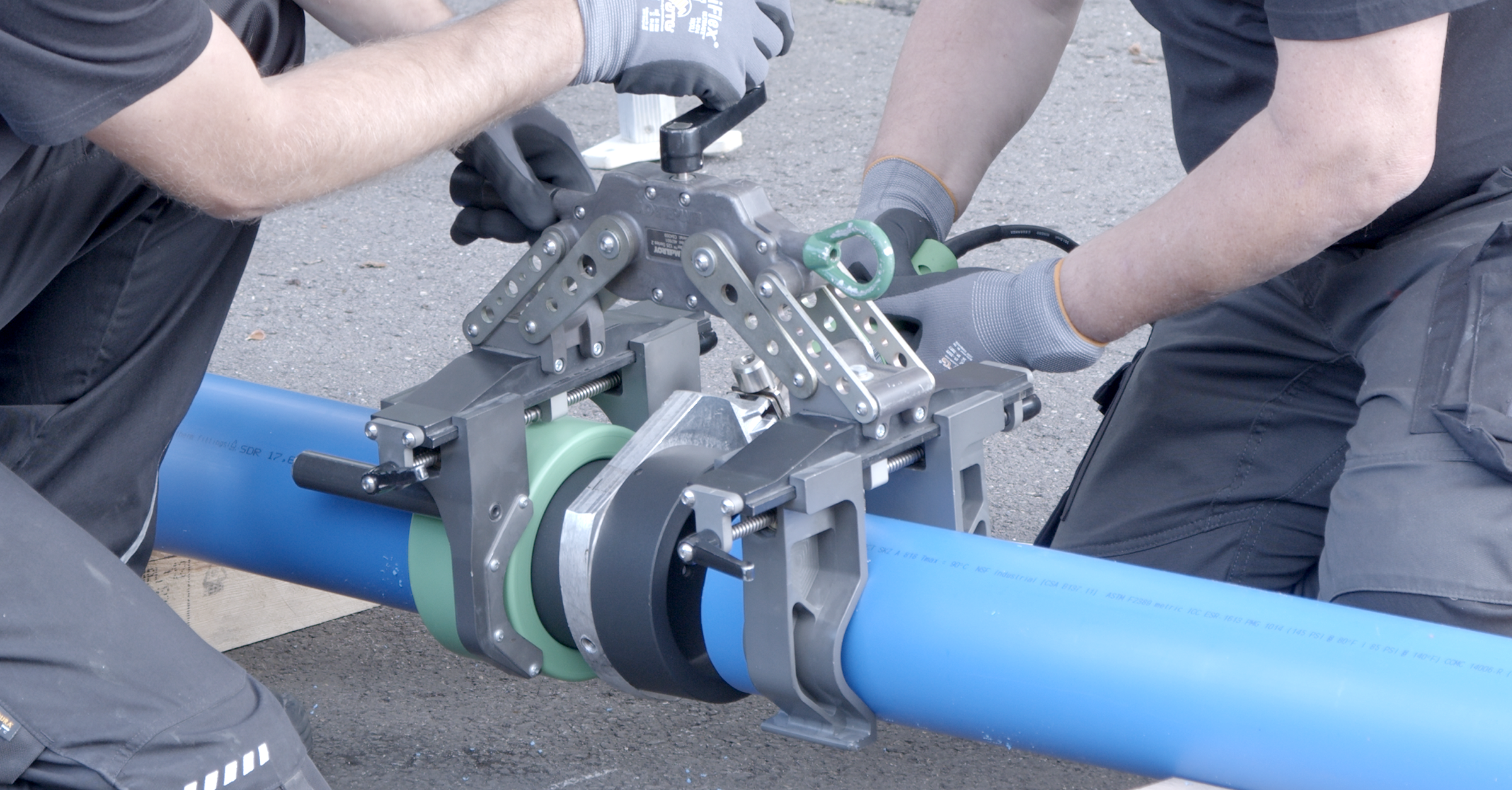
A PP welding process is a plastic welding process for components made of polypropylene. The joining surfaces are heated until the thermoplastic material in the joint area becomes plasticised.
The components are then joined under defined conditions. As the material cools, it solidifies again. This creates a material-bonded joint. It is dimensionally stable and forms part of the pipework system.
This means that welding differs fundamentally from bonded, screwed or mechanically crimped joints. In the PP welding process, the joint is formed from the material itself. For pipework design, this means that the pipe, fitting and welding process must be designed in conjunction with one another. Only then will the joint be able to withstand the subsequent stresses caused by the medium, pressure and temperature.
Typical applications for welded PP pipework systems include:
- Building services
- Heating and cooling systems
- [Data centre cooling](https://blog.aquatherm.de/en/cool-head-for-ai-aquatherm-pipes) and chilled water networks
- Industrial plants and process plant engineering
- Water and utility pipes
- Drinking water supply with additional requirements regarding hygiene, material approvals, temperature resistance and system compatibility
- Chemical or technical media, provided the system and materials are approved for this purpose
## Advantages and applications of welded PP pipework systems
Welded PP pipework systems combine pipes, fittings and valves to form a coherent system. The technical advantage lies in the system’s design philosophy. The welded joint is regarded as part of a coordinated pipework system: pipe material, fitting geometry, tooling, welding parameters and processing specifications all interlock.
Plastic welding technology also offers hydraulic advantages. It creates a compact pipe-fitting connection without any additional sealing points at the joint. This reduces structural disruptions to the flow pattern and promotes uniform flow of the medium. Particularly in extensively branched pipe networks, cooling circuits or technical supply lines, this can help to limit pressure losses and keep the system design cost-effective.
There is also a regulatory aspect to consider. In view of stricter European regulations, which are increasingly restricting the use of PFAS (per- and polyfluoroalkyl substances) in seals, threadlockers, etc., seal-free plastic welding technology can offer greater planning certainty for plant operators.
## An overview of plastic welding processes: What methods are available?
The method of heat input is the distinguishing feature of PP welding processes. Heat can be applied via a heating element, hot gas, integrated heating coils, friction, ultrasound, laser or electromagnetic methods. The choice of which PP welding process is technically appropriate is determined by the material, component geometry, wall thickness, installation situation and quality requirements.
| **Methods** | **Principle of heat input** | **Typical classification** | **Significance for PP pipework systems** |
| --- | --- | --- | --- |
| Heating element socket welding | Heated tools for pipe and socket | Pipe-fitting joints | An important process for many installation situations |
| Heating element butt welding | Heated element applied to the end faces | Pipe-to-pipe joints | Important for larger dimensions and certain system designs |
| Electric socket welding / heating coil welding | Integrated heating wires in the socket | Connection using special system sockets | Suitable provided that appropriate components are provided |
| Infrared welding | Contactless heating | Industrial applications with high demands on process control and cleanliness | More suited to demanding manufacturing and process environments |
| Hot gas and extrusion welding | Hot gas and, where applicable, welding filler material | Plates, vessels, special components | In pipe systems, usually as a supplementary method or for special designs |
| Ultrasonic, laser, friction and vibration welding | Mechanical or electromagnetic energy | Mass production, component assembly | Usually carried out as a secondary process for conventional on-site assembly of PP pipes |
The table outlines the technical framework but does not replace a system assessment. In projects with defined pipe classes, the joining technique must be suitable for the medium, pressure, temperature, material, dimensions and approved components. A process may be technically feasible for a particular material but still be unsuitable for a specific installation scenario because of issues with tool access, wall thickness, the testing concept or manufacturer approval.
## Which PP welding methods are relevant for pipework systems?
For PP pipework systems, the focus is primarily on processes that can be reliably controlled on site, in the workshop or during prefabrication. These include heating-element socket welding, heating-element butt welding and, depending on the system, electrofusion socket welding. Other plastic welding processes remain of technical interest but are not automatically suitable for pipes, fittings and installation conditions.
### Heating-element socket welding
In heating-element socket welding, the pipe end and socket are heated simultaneously using suitable tools. The pipe end is plastified on the outside, and the socket on the inside. For PP-R, the heating-element temperature is listed at around 260 °C in many processing tables; however, the specifications of the respective pipe system are always binding.
After heating, both parts are joined quickly, in a straight line and without twisting. During the cooling period, the joint must remain free of stress. The joint is formed via the softened contact surfaces of the pipe and fitting.
This PP welding process is suitable for many typical pipe-fitting joints in building services and plant engineering. It requires clean cut edges, prepared joint surfaces, the correct insertion depth, an appropriate heating time and a carefully controlled cooling phase ( ). Insufficient heating, contaminated surfaces or movement during cooling can compromise the quality of the joint.
### Heating-element butt welding
In heating-element butt welding, the end faces of the pipe ends are prepared and aligned axially before being heated against a flat heating element. For PP-R and PP systems, DVS-based processing tables frequently specify a heating element temperature of 210 °C ± 10 °C; here too, the manufacturer’s specific guidelines apply.
Once the heating element has been removed, the plastified end faces are joined under a defined joining pressure. A circumferential weld bead forms at the joint. During the visual inspection, its shape, uniformity and symmetry are assessed. A cleanly formed bead indicates that the end faces have been prepared flat, that sufficient heating has taken place, that the joining pressure is appropriate, and that the pipes are correctly aligned axially.
The PP welding process is particularly important for larger dimensions and certain plant designs. Its quality depends heavily on preparation and alignment. Pipe ends must be machined to be square, clean and flat. Changeover time, joining pressure and cooling time also influence the result. The larger the dimension and wall thickness, the more important stable clamping technology, defined process control and documentable parameters become.
### Electrofusion Sleeve Welding
Electrofusion welding complements these PP welding processes, provided that suitable system components are available. Integrated heating wires in the socket heat the joint zone electrically and fuse the pipe and socket together. This can offer advantages in the case of repairs, in constrained situations or in areas that are difficult to access.
#### Prefabrication as a factor in assembly and quality
For projects involving recurring assemblies, prefabrication can make economic sense. Certain pipe sections, manifolds or system modules can be prepared, welded, marked and documented under controlled conditions before being assembled on site. The [aquatherm prefabrication](https://www.aquatherm.de/en/solutions-products/products/aquatherm-services/prefabrication-1/) system is a prime example of this.
It integrates joining technology at an early stage into the installation concept and reduces installation times on site. Further advantages lie in the process environment: prefabrication at the factory facilitates dimensional control, tool availability, clean joint surfaces, marking and repeatability. This means fewer joints need to be made on site under cramped or changing conditions.
## Selection guide: Which welding process for plastics is suitable for the application?
The selection of a PP welding process does not begin with the tooling, but with the application. A pipework system for drinking water, cooling water, heating, technical media or industrial processes places different demands on the material, pressure rating, temperature range, resistance and documentation. Before making a selection, the following questions should be clarified:
- What medium is being transported and what level of chemical resistance is required?
- What operating pressures, temperatures and cyclic loads occur during normal operation and at peak loads?
- What pipe dimensions, wall thicknesses and fittings are required?
- Is this a new build, an extension, a repair or a refurbishment of an existing building?
- What space constraints, accessibility issues and environmental conditions will affect the installation?
- Which connections will be made on site, and which assemblies can be prefabricated?
- What tests, markings and documentation does the project require?
These questions give rise to the technical criteria: application, pipework system, dimensions, installation situation, installation concept, degree of prefabrication and manufacturer approval. What works well in an open installation area with a butt-welding machine may fail due to a lack of access for tools or limited space in a tightly packed service shaft. Conversely, prefabrication may be advisable where there are recurring assemblies, tight deadlines or stringent documentation requirements.
For larger projects, verification procedures must also be taken into account. Welding parameters, tool approvals, tests and markings must be traceable, particularly for industrial plants, critical media or where high quality assurance requirements apply. Technical documentation provides the basis for this: data sheets, processing tables, compatibility lists and assembly specifications define which processes are permitted for which pipe systems. General information on plastic welding technology helps to provide guidance, but does not replace project-specific verification.
## The plastic welding process: preparation, heating and cooling time
The entire PP welding process is structured and follows the procedure explicitly described in the DVS 2207-11 guideline. The details vary depending on the process, dimensions and manufacturer’s specifications. A general description is therefore insufficient as an installation guide. However, for a technical understanding, it is crucial to recognise why preparation, heating, joining, cooling and testing are interlinked.
**1. Preparation and cutting**
First, the pipe is cut to length at right angles. Skewed cuts can lead to uneven heating and reduce the effective joint area. The cut edges are deburred and chamfered depending on the plastic welding process. Joint surfaces must be clean, dry and free from residues. Where necessary, suitable cleaners approved by the system manufacturer must be used.
**2. Marking the insertion depth**
In socket welding, the insertion depth is marked on the pipe before heating. This prevents the pipe from being pushed too far or not far enough into the fitting during joining. An incorrect insertion depth can force molten material into the pipe cross-section and impair the system’s hydraulic performance.
**3. Heating, joining and cooling**
The components are heated in accordance with the manufacturer’s specifications. The temperature of the heating element, heating time, transition time, joining pressure and cooling time depend on the PP welding process, pipe dimensions and wall thickness. During joining, the components must be brought together in a straight line and without twisting. Subsequent adjustment may impair the initial bonding of the plasticised joint surfaces. The joint must then be allowed to cool under low stress. Premature loading or artificially accelerated cooling may promote internal stresses and impair the joint’s subsequent load-bearing capacity.
**4. Tests and documentation**
Testing follows the joining process. The weld can be tested using non-destructive and/or destructive methods. A visual inspection is also part of the process. Depending on the project, pressure testing, documented welding parameters, marking of the weld or allocation to a test report may be carried out.
This traceability becomes even more important in prefabrication and in BIM-driven projects. An isometric drawing of a pipework system, available at , can provide the basis for cutting to size, assembly production, labelling and testing. If welding parameters, test reports or as-built data are recorded in a structured manner, individual joints can be identified more clearly at a later stage. Where welding machines record digital process data, they can support quality assurance and the handover to operations or facility management.
## Conclusion: Selecting the right PP welding process and applying it safely
Not every plastic welding process is equally suitable for PP and PP-R pipework systems. In practice, heating-element socket welding, heating-element butt welding and, depending on the system, electrofusion socket welding are the main joining techniques used.
The quality of the joint depends on several factors: suitable material, approved components, correct dimensions, clean joint surfaces, approved tools, correct process parameters and professional execution. If these points are incorporated early on into the planning and installation concept, this improves the technical quality and cost-effectiveness of a plant project.
### Questions about PP welding processes for pipe joints?
aquatherm supports you in selecting and implementing suitable PP pipework systems with expert and competent advice, technical documentation, installation guidelines, system components, training and prefabrication options.
Let our [experts advise you on your project](https://www.aquatherm.de/en/company/contact/), with no obligation.
[](https://hubspot-cta-redirect-eu1-prod.s3.amazonaws.com/cta/redirect/25129160/3e40de1c-13cd-40df-a07c-458091643e9e)
[To overview page](https://blog.aquatherm.de/)
#### Topics
- [BIM (3)](https://blog.aquatherm.de/en/tag/bim)
- [District heating (14)](https://blog.aquatherm.de/en/tag/district-heating)
- [Drinking water (8)](https://blog.aquatherm.de/en/tag/drinking-water)
- [Further topics (12)](https://blog.aquatherm.de/en/tag/further-topics)
- [Maritime applications (4)](https://blog.aquatherm.de/en/tag/maritime-applications)
- [Modern data centre cooling (12)](https://blog.aquatherm.de/en/tag/modern-data-centre-cooling)
- [Prefabrication (4)](https://blog.aquatherm.de/en/tag/prefabrication)
- [Processing (3)](https://blog.aquatherm.de/en/tag/processing)
- [Surface heating & cooling (5)](https://blog.aquatherm.de/en/tag/surface-heating-cooling)
Show more
---
#### Top 5 Posts
| 1 | [PP welding methods for secure pipe joints](https://blog.aquatherm.de/en/pp-welding-methods-for-secure-pipe-joints) |
| --- | --- |
| 2 | [Drinking Water Ordinance: Obligations for businesses explained simply](https://blog.aquatherm.de/en/drinking-water-ordinance-obligations-for-businesses-explained-simply) |
| 3 | [Backflow preventers in drinking water systems: What matters](https://blog.aquatherm.de/en/backflow-preventers-in-drinking-water-systems-what-matters) |
| 4 | [Drinking water supply: Systems, planning and infrastructure](https://blog.aquatherm.de/en/drinking-water-supply-systems-planning-infrastructure) |
| 5 | [Drinking water hygiene: What matters in building installations](https://blog.aquatherm.de/en/driniking-water-hygiene-what-matters-in-building-installations) |
---
### Subscribe to our newsletter:
Deutschland
aquatherm GmbH | Biggen 5
57439 Attendorn | Germany
Phone: **+49 2722 950 0**
Mail: **info@aquatherm.de**
[Contact](https://www.aquatherm.de/en/company/contact/)
Newsletter abonnieren
Закрыть
- - APPLICATION FIELDS
- [Heating system construction](https://www.aquatherm.de/en/solutions-products/applications/heating-system-construction/)
- [Refrigeration](https://www.aquatherm.de/en/solutions-products/applications/refrigeration/)
- [Heating and cooling networks](https://www.aquatherm.de/en/solutions-products/applications/heating-and-cooling-networks/)
- [Fire protection and sprinkler systems](https://www.aquatherm.de/en/solutions-products/applications/fire-protection-and-sprinkler-systems/)
- [All applications](https://www.aquatherm.de/en/solutions-products/applications/)
- - INDUSTRIES
- [Data centres](https://www.aquatherm.de/en/solutions-products/industries/data-centres/)
- [Infrastructure](https://www.aquatherm.de/en/solutions-products/industries/infrastructure/)
- [Health sector](https://www.aquatherm.de/en/solutions-products/industries/health-sector/)
- [Industrial buildings](https://www.aquatherm.de/en/solutions-products/industries/industrial-buildings/)
- [All sectors](https://www.aquatherm.de/en/solutions-products/industries/)
- - Service
- [Knowledge Base](https://www.aquatherm.de/en/aquatherm-knowhow/knowledge-base/)
- [Planning tools](https://www.aquatherm.de/en/aquatherm-knowhow/planning-tools/)
- [Trainings](https://www.aquatherm.de/en/aquatherm-knowhow/trainings/)
- [Contact](https://www.aquatherm.de/en/company/contact/)
- [All services](https://www.aquatherm.de/en/aquatherm-knowhow/)
- - Quicklinks
- [Blog](https://blog.aquatherm.de/en)
- [News](https://www.aquatherm.de/en/company/news/)
- [Frequently asked questions](https://www.aquatherm.de/en/aquatherm-knowhow/knowledge-base/frequently-asked-questions/)
- - Products
- [aquatherm black](https://www.aquatherm.de/en/solutions-products/products/aquatherm-black/)
- [aquatherm blue](https://www.aquatherm.de/en/solutions-products/products/aquatherm-blue/)
- [aquatherm green](https://www.aquatherm.de/en/solutions-products/products/aquatherm-green/)
- [aquatherm red](https://www.aquatherm.de/en/solutions-products/products/aquatherm-red/)
- [aquatherm energy](https://www.aquatherm.de/en/solutions-products/products/aquatherm-energy/)
- [aquatherm services](https://www.aquatherm.de/en/solutions-products/products/aquatherm-services/)
- [All products](https://www.aquatherm.de/en/solutions-products/products/)
- - References
- [Orsolina28, Italy](https://www.aquatherm.de/en/solutions-products/references/orsolina28-italy/)
- [“mikado”, Germany](https://www.aquatherm.de/en/solutions-products/references/mikado-germany/)
- [DJO, Germany](https://www.aquatherm.de/en/solutions-products/references/djo-germany/)
- [Multivac, Germany](https://www.aquatherm.de/en/solutions-products/references/multivac-germany/)
- [Spree tower, Germany](https://www.aquatherm.de/en/solutions-products/references/spree-tower-germany/)
- [Vioser S.A., Greece](https://www.aquatherm.de/en/solutions-products/references/vioser-sa-greece/)
- [All references](https://www.aquatherm.de/en/solutions-products/references/)
- - Company
- [About us](https://www.aquatherm.de/en/company/about-us/)
- [Locations](https://www.aquatherm.de/en/company/locations/)
- [News](https://www.aquatherm.de/en/company/news/)
- [Everything about the company](https://www.aquatherm.de/en/company/)
---
Copyright © 2026 aquatherm GmbH. All rights reserved.
EN
---
- [Privacy policy](https://www.aquatherm.de/en/privacy-policy/)
- [Imprint](https://www.aquatherm.de/en/imprint)
- [Legal notice](https://www.aquatherm.de/en/legal-notice/)
- [T&Cs](https://www.aquatherm.de/en/tcs)
---
---
All content presented on this regional aquatherm website applies globally.
[Back to top](https://blog.aquatherm.de/en/pp-welding-methods-for-secure-pipe-joints#top)
```json
{
"@context" : "https://schema.org",
"@type" : "BlogPosting",
"author" : {
"@type" : "Person",
"name" : "Admin",
"url" : "https://blog.aquatherm.de/en/author/admin"
},
"dateModified" : "2026-11-04T07:53:53.779Z",
"datePublished" : "2026-11-04T07:53:53.000Z",
"headline" : "PP welding methods for secure pipe joints",
"image" : [ "https://blog.aquatherm.de/hubfs/blog-schwei_C3_9Fen-b.png" ],
"mainEntityOfPage" : {
"@id" : "https://blog.aquatherm.de/en/pp-welding-methods-for-secure-pipe-joints",
"@type" : "WebPage"
},
"publisher" : {
"@type" : "Organization",
"logo" : {
"@type" : "ImageObject",
"url" : "https://blog.aquatherm.de/hubfs/aquatherm_Logo_RGB_gradient-green_mSZ.png"
},
"name" : "aquatherm GmbH"
}
}
```