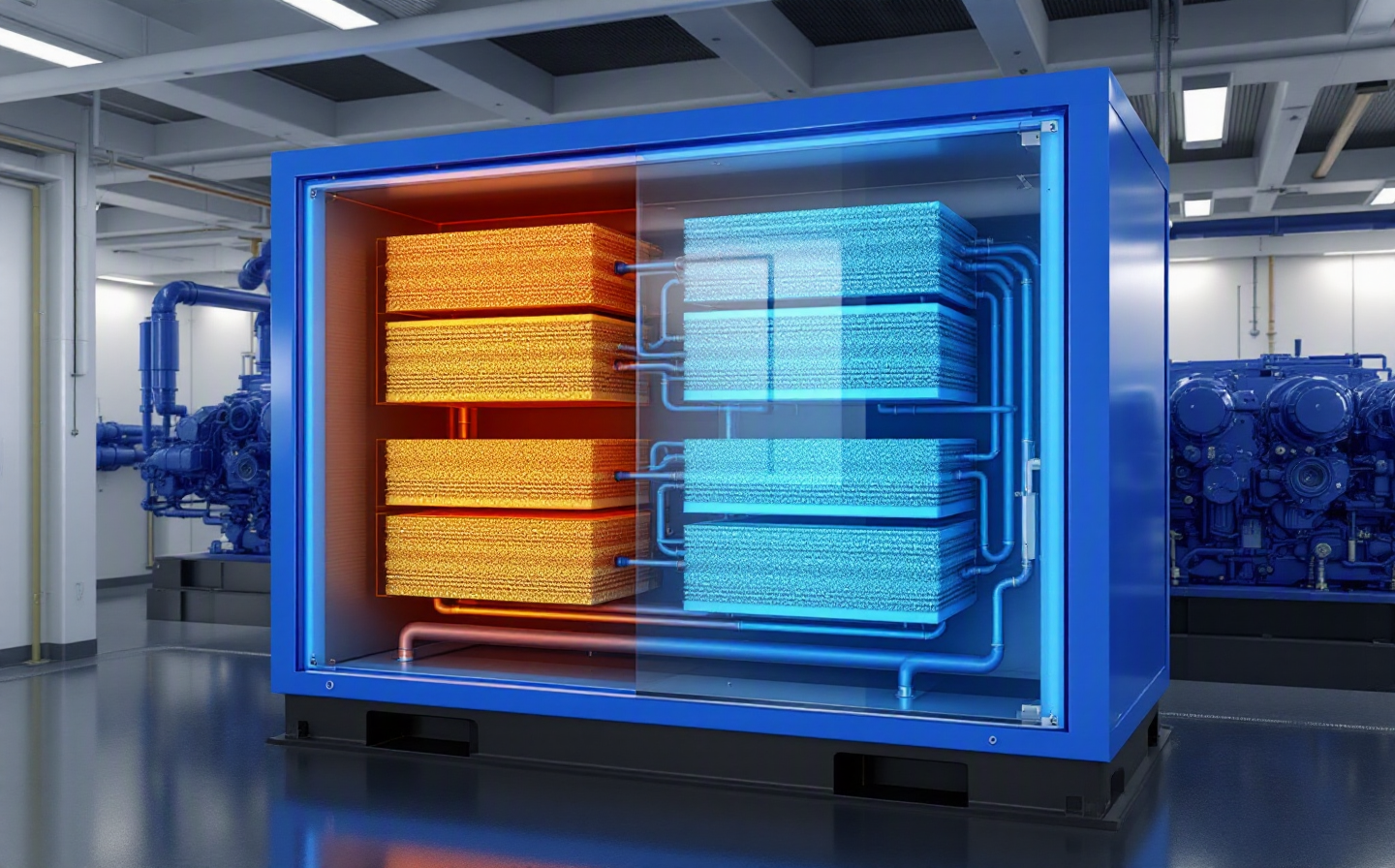
A modern marine diesel engine is a powerhouse, but it has a physical limitation: more than 50 per cent of the fuel energy used is lost as waste heat. Adsorption chillers offer a solution for shipbuilding. Instead of using electricity from additional diesel generators to power mechanical refrigeration units, they convert the waste heat already generated by the ship’s propulsion system into useful cooling on board. This is becoming increasingly important in light of the IMO’s regulatory requirements for CO₂ reduction through the EEDI (Energy Efficiency Design Index) and the CII (Carbon Intensity Indicator).
What is an adsorption chiller?
The adsorption chiller (AdKM) is a so-called thermally driven refrigeration system. It operates without a mechanical compressor and utilises the physical process of adsorption. In an adsorption chiller, a gas adsorbs onto the porous surface of a solid material. This solid material, known as the sorbent, is fixed in place within chambers (the adsorber). Even if the ship encounters heavy seas, the sorbent material remains where it belongs. This makes the AdKM the more robust choice for maritime applications.
The materials: zeolite and silica gel
High-performance materials with a vast internal surface area are used as adsorbents. Silica gel or zeolite are the most commonly used. A single gram of zeolite can have an internal surface area of over 1,000 square metres, thanks to its microscopically small pores and channels. This material acts as a kind of molecular sponge.
The refrigerant: distilled water
Distilled water is used as the refrigerant. Water is readily available on ships, is non-toxic and non-flammable, and offers a high specific enthalpy of vaporisation. This means that when water evaporates, it extracts a large amount of thermal energy from its surroundings. As the water in the system is under a strong vacuum (negative pressure), it does not evaporate at 100 °C, but at a cool 3 to 5 °C. The adsorption chiller therefore makes use of the tendency of dry silica gel or zeolite to draw this cold water vapour into its pores.
Adsorption chiller: how it works, simply explained
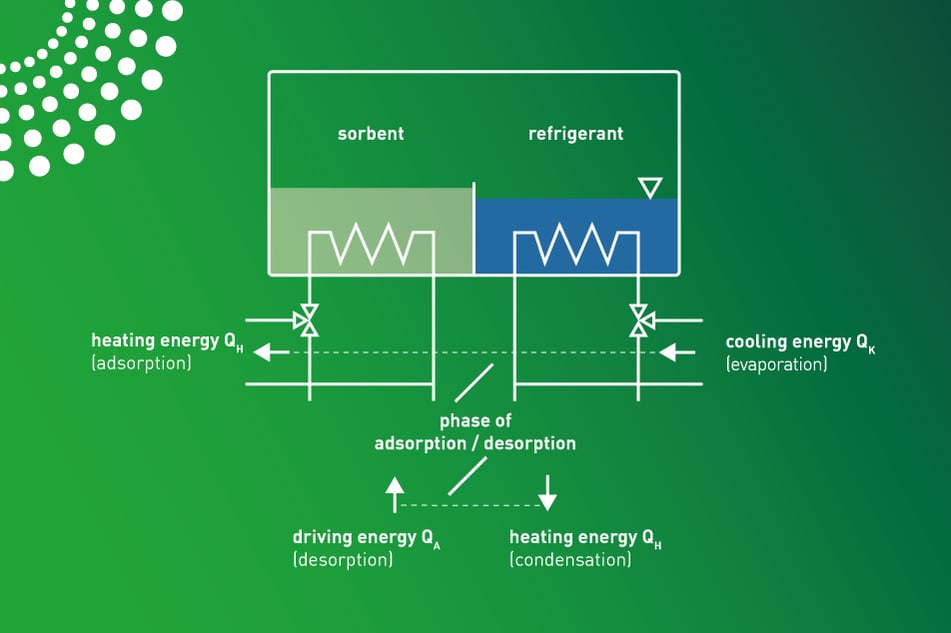
The operation of the adsorption chiller can be reduced to a simple principle. As the physical process of adsorption is inherently discontinuous – a sorbent must first absorb moisture and then be dried again – systems designed for continuous operation generally use two modules that operate in an anticyclic (phase-shifted) manner.
Hydraulically, an adsorption chiller consists of three circuits: the drive circuit (hot cooling water from the ship’s engine), the chilled water circuit (useful cooling for the consumers), and the recooling circuit (usually operated with seawater). Unlike conventional compression chillers, this entire process does not require mechanical compressors and uses the hot water already produced by the ship’s engines as a thermal compressor. The cold is generated in hermetically sealed chambers under an extreme vacuum and passes through four phases.
- Desorption (regeneration): In the first chamber, the sorbent (e.g. silica gel) is heavily saturated with water. Thermal energy is then supplied to the adsorber in the form of hot cooling water (approx. 70 to 90 °C) from the high-temperature circuit (HT) of the main or auxiliary diesel engines. This heat causes the bound water to evaporate from the microscopic pores of the solid. The adsorbent is thereby ‘dried’ and regenerated. This process is called desorption.
- Condensation (liquefaction): The hot, expelled water vapour flows into the condenser. There, it is cooled via heat exchangers connected to the ship’s return cooling circuit (seawater). The vapour releases its heat, condenses, and returns to liquid water.
- Evaporation (cooling): The liquid refrigerant is now fed into the evaporator via a valve. This is where the physical peculiarity of the vacuum comes into play: at a system pressure of, for example, just 10 mbar (1000 pascals), water does not evaporate at 100 °C, but at a mere 5 °C to 7 °C. To change from a liquid to a gaseous state, the water requires evaporation enthalpy (energy). It draws this energy from the chilled water circuit, and at this moment the valuable useful cooling is generated.
- Adsorption (binding): The ice-cold water vapour from the evaporator flows into the second chamber. Here, the previously dried, absorbent silica gel awaits. It absorbs the water vapour (adsorption). This binding to the solid material in turn generates heat of formation, which must be continuously dissipated via the seawater cooling circuit. Once the material in the second chamber is saturated, the valves switch over and the cycle begins again.
Adsorption cooling in shipbuilding: heat sources, applications and requirements
A modern ship is a self-sufficient, complex ecosystem. It is, in effect, a floating micro-city that must function smoothly, sometimes for months on end, far from any onshore infrastructure. One of the most important factors in ship construction is thermal management. But what exactly is cooling actually needed for at sea?
Refrigeration on ships is essentially divided into four main areas of application:
- Air conditioning (HVAC) for passengers and crew
- Cooling of sensitive on-board electronics and IT
- Provision cooling systems for self-sufficient crossings
- Cargo cooling and maintaining unbroken cold chains (reefers)
All these essential applications have one thing in common: if they are operated exclusively by conventional electric compression chillers, they consume large amounts of electricity. This electricity must be generated by the ship’s diesel-powered auxiliary generators (auxiliary engines), which is both costly and emissions-intensive. This is where adsorption chillers come into their own: they continuously supply chilled water at 5 to 7 °C. This makes them ideal for supporting the largest energy consumers on board – cabin air conditioning and server room cooling – at virtually no additional operating cost and using only waste heat from the engines.
The efficiency of the adsorption chiller in practice
A building services engineer accustomed to conventional refrigeration technology would be surprised by the efficiency of an adsorption chiller. The coefficient of performance (COP) for these systems is often only between 0.5 and 0.7. This means that around 50 to 70 kW of cooling capacity is generated from 100 kW of thermal drive energy.
What looks like low efficiency on paper is an economic and ecological advantage on a ship. The waste heat used is, in fact, free. It is a by-product of engine cooling that would otherwise simply be discharged into the sea. Operating the adsorption system requires only minimal electricity for the circulation pumps and the sensor systems.
Advantages and limitations of adsorption cooling in maritime applications
The decision to adopt thermally driven cooling is a regulatory and strategic necessity for ship operators. Switching to adsorption cooling addresses several core issues in modern shipping at once.
Reduction in electrical energy consumption
Conventional, electricity-driven compression chillers are among the biggest consumers in the ship’s electrical system. By utilising waste heat that is already available as a power source, the adsorption chiller reduces electricity demand for refrigeration by up to 80 per cent. This takes a huge load off the auxiliary diesel engines, saves thousands of tonnes of fuel per year, and drastically improves the ship’s CII rating.
Maximum robustness in rough seas
The laws of physics at sea are different from those on land. A ship pitches, rolls and vibrates constantly. Whilst absorption chillers (using liquid refrigerants) can suffer performance losses due to sloshing in the tank, the adsorption chiller uses a solid material (silica gel or zeolite). This immobile solid guarantees a stable, trouble-free process, even when the ship is manoeuvring through the roughest seas.
Virtually maintenance-free
A system that does not have large mechanical compressors is also not subject to significant mechanical wear. The vacuum pumps and circulation pumps are the only moving parts. This reduces maintenance intervals, lowers spare parts costs, and eases the workload on the crew in the engine room.
100% environmentally friendly refrigerant
Fluorinated greenhouse gases (F-gases) used as refrigerants are becoming increasingly strictly regulated and expensive due to international regulations (such as the Kigali Amendment). The AdKM uses pure water as a refrigerant. It is non-toxic, non-flammable, and has a Global Warming Potential (GWP) of zero. In the event of a leak, there is no danger to either the environment or the crew.
Compliance with regulatory requirements
The efficiency gains achieved through adsorption cooling are more important today than ever before. Since the start of 2023, strict IMO regulations on energy efficiency and carbon intensity have applied to international shipping, including the EEXI (Energy Efficiency Existing Ship Index) and the CII (Carbon Intensity Indicator). A ship that receives a poor CII rating (D or E) is required to submit rectification plans and risks losing its operating licence.
As the electricity on ships is generated by diesel generators, every kilowatt-hour of electricity saved on cooling automatically improves the carbon footprint. Industry pioneers are already leading the way: as part of the EU research project Engimmonia, an optimised adsorption chiller is being tested on the passenger ferry F/B Elyros, which uses engine waste heat specifically to cool large passenger areas.
Adsorption cooling in shipbuilding: requirements for piping systems
No matter how advanced an adsorption chiller in the engine room may be, it loses its technological and economic value if the generated cooling is lost on its way to the consumers. On large cargo or cruise ships, the water cooled to 5 to 7 °C in the evaporator often has to be transported hundreds of metres – to the air conditioning units in the cabins, to cold stores for provisions, or to server and technical rooms. The quality of the building services engineering design is particularly evident in the distribution of media. Conditions at sea are extremely demanding for piping systems.
- Harsh climate: The salty sea air inevitably leads to severe external corrosion in conventional metal pipes. The cooling medium inside can also cause pitting corrosion due to oxygen ingress.
- Condensation (moisture): The high humidity at sea is the enemy of any refrigeration pipe. Metal conducts cold extremely well. If the often error-prone and heavy insulation on metal pipes has even the smallest gaps, condensation forms on the ice-cold pipe surface.
- Weight: Metal pipes are heavy. In shipbuilding, however, every kilogram counts. More weight means greater draught, higher water resistance and ultimately higher fuel consumption.
The solution for refrigeration networks: aquatherm blue
To ensure the system’s thermal cycle is completely loss-free, safe and durable, shipyards, designers and shipping companies rely on advanced plastic piping systems such as aquatherm blue. The pipe, made of highly resistant polypropylene (PP-RCT), has been specially developed to meet the challenges of refrigeration and air conditioning technology and fully demonstrates its strengths in maritime applications.
- Corrosion resistance: Polypropylene reacts neither with salt water nor with humid sea air. Perforation, deposits or pitting are physically and chemically impossible. The piping system lasts for the entire service life of the vessel.
- Insulating effect: Plastic has a thermal conductivity many times lower than that of metal. The cold remains inside the pipe. This minimises the risk of condensation forming.
- Weight saving: aquatherm blue is significantly lighter than steel or copper pipes. A complete piping system on a ship can save several tonnes in weight.
- Material-bonded connection: Through electrofusion or butt welding, the pipe and fitting fuse to form a homogeneous, material-bonded unit. Unlike pressed or screwed metal connections, which can loosen due to constant ship vibrations, aquatherm blue creates a leak-proof and permanently vibration-resistant connection.
Conclusion: Making sensible use of waste heat on ships with adsorption chillers
The shipping industry must drastically reduce emissions and fuel consumption. Adsorption chillers make a significant contribution to this: they convert engine waste heat, which is already available, directly into useful cooling. This elimination of power-hungry compressors saves up to 80 per cent of electrical cooling energy and significantly improves the ship’s mandatory CII rating. As the system uses water as a refrigerant and solid sorbents, it is also completely unaffected by heavy seas and strict environmental regulations.
However, the highest efficiency in cooling is lost if the infrastructure is not optimally designed. Salty sea air, high humidity and constant vibrations push conventional metal pipes to their limits due to corrosion and condensation. Future-proof and cost-effective building services planning at sea therefore requires a change of system for media distribution. Only with lightweight, thermally insulating and permanently corrosion-free plastic piping systems such as aquatherm blue (PP-RCT) can the thermal circuit be closed safely and without loss of cooling capacity.
Talk to our experts
Are you planning to integrate a climate-friendly adsorption refrigeration system at sea or looking for durable, corrosion-free piping systems for maritime refrigeration circuits? Whether for newbuilds or retrofits, aquatherm supports planners, shipyards and shipowners from the initial route planning and material specification through to final implementation. Take advantage of our expertise in the maritime sector.