---
title: "Prefabrication: Practical benefits"
description: "Planning reliability, reduced pressure on construction sites and tailor-made solutions: Find out what advantages prefabrication offers ► Read now."
image: https://blog.aquatherm.de/hubfs/Blog/Vorteile%20bei%20der%20Vorfertigung/vorteile-bei-der-vorfertigung.jpg
---
Deutschland
[tel:+491234567](tel:+491234567)
Global
Menu
close
- - Menu
- Solutions & Products
- [Solutions & Products](https://www.aquatherm.de/en/solutions-products/)
- Products
- [Products](https://www.aquatherm.de/en/solutions-products/products/)
- [AQUATHERM BLACK](https://www.aquatherm.de/en/solutions-products/products/aquatherm-black/)
- [AQUATHERM BLUE](https://www.aquatherm.de/en/solutions-products/products/aquatherm-blue/)
- [AQUATHERM GREEN](https://www.aquatherm.de/en/solutions-products/products/aquatherm-green/)
- [AQUATHERM RED](https://www.aquatherm.de/en/solutions-products/products/aquatherm-red/)
- [AQUATHERM ENERGY](https://www.aquatherm.de/en/solutions-products/products/aquatherm-energy/)
- [AQUATHERM SERVICES](https://www.aquatherm.de/en/solutions-products/products/aquatherm-services/)
- [Applications](https://www.aquatherm.de/en/solutions-products/applications/)
- [Industries](https://www.aquatherm.de/en/solutions-products/industries/)
- [References](https://www.aquatherm.de/en/solutions-products/references/)
- aquatherm know-how
- [aquatherm know-how](https://www.aquatherm.de/en/aquatherm-knowhow/)
- Planning tools
- [Planning tools](https://www.aquatherm.de/en/aquatherm-knowhow/planning-tools/)
- [Product finder](https://www.aquatherm.de/en/aquatherm-knowhow/planning-tools/product-finder/)
- [BIM-Data](https://www.aquatherm.de/en/aquatherm-knowhow/planning-tools/bim-data/)
- [Head loss calculator](https://www.aquatherm.de/en/aquatherm-knowhow/planning-tools/head-loss-calculator/)
- [Linear expansion calculator](https://www.aquatherm.de/en/aquatherm-knowhow/planning-tools/linear-expansion-calculator/)
- [Trainings](https://www.aquatherm.de/en/aquatherm-knowhow/trainings/)
- Processing
- [Processing](https://www.aquatherm.de/en/aquatherm-knowhow/processing/)
- [AQUATHERM BLACK](https://www.aquatherm.de/en/aquatherm-knowhow/processing/aquatherm-black/)
- [AQUATHERM BLUE](https://www.aquatherm.de/en/aquatherm-knowhow/processing/aquatherm-blue/)
- [AQUATHERM GREEN](https://www.aquatherm.de/en/aquatherm-knowhow/processing/aquatherm-green/)
- [AQUATHERM RED](https://www.aquatherm.de/en/aquatherm-knowhow/processing/aquatherm-red/)
- [AQUATHERM ENERGY](https://www.aquatherm.de/en/aquatherm-knowhow/processing/aquatherm-energy/)
- Knowledge Base
- [Knowledge Base](https://www.aquatherm.de/en/aquatherm-knowhow/knowledge-base/)
- [Blog](https://blog.aquatherm.de/en)
- [Content Hub](https://info.aquatherm.de/en/aquatherm-whitepaper-guide-for-download)
- [EPDs and Certificates](https://www.aquatherm.de/en/aquatherm-knowhow/knowledge-base/epds-and-certificates/)
- [Downloads](https://www.aquatherm.de/en/aquatherm-knowhow/knowledge-base/downloads/)
- [Frequently asked questions](https://www.aquatherm.de/en/aquatherm-knowhow/knowledge-base/frequently-asked-questions/)
- Company
- [Company](https://www.aquatherm.de/en/company/)
- About us
- [About us](https://www.aquatherm.de/en/company/about-us/)
- [Sustainability](https://www.aquatherm.de/en/company/about-us/sustainability/)
- [Quality](https://www.aquatherm.de/en/company/about-us/quality/)
- [Management](https://www.aquatherm.de/en/company/about-us/management/)
- [Locations](https://www.aquatherm.de/en/company/locations/)
- [International partners](https://www.aquatherm.de/en/company/international-partners/)
- [News](https://www.aquatherm.de/en/company/news/)
- [Contact](https://www.aquatherm.de/en/company/contact/)
- [Call aquatherm](tel:+4927229500)
- [Search](https://www.aquatherm.de/en/find/)
- Choose Language
- Quicklinks
- [Contact](https://www.aquatherm.de/en/company/contact/)
- [Find international partners](https://www.aquatherm.de/en/company/international-partners/)
- [Blog](https://blog.aquatherm.de/en)
- [Content Hub](https://info.aquatherm.de/en/aquatherm-whitepaper-guide-for-download)
- [Planning tools](https://www.aquatherm.de/en/aquatherm-knowhow/planning-tools/)
- [Downloads](https://www.aquatherm.de/en/aquatherm-knowhow/knowledge-base/downloads/)
- [News](https://www.aquatherm.de/en/company/news/)
###### Germany
##### Wählen Sie Ihre Region:
[Germany](https://blog.aquatherm.de/vorteile-der-vorfertigung-in-der-praxis) [Global](https://blog.aquatherm.de/) [United Kingdom](https://blog.aquatherm.de/en-gb/prefabrication-practical-benefits) [Italy](https://blog.aquatherm.de/it/vantaggi-della-prefabbricazione-nella-pratica) [Iberica](https://blog.aquatherm.de/)
Prefabrication
# Prefabrication: Practical benefits \_\_
1.
2. [aquatherm Blog](https://blog.aquatherm.de/en)
3. Prefabrication: Practical benefits
23\. April 2026 4 min.
In modern pipework construction, the trend towards prefabricated manifolds and special components is becoming increasingly prevalent. Prefabrication is particularly important where individual requirements, high quality standards, and demanding construction projects converge. In this article, you will learn what prefabrication is, why it makes sense, and in which areas of application it demonstrates its strengths.
#### Key points at a glance:
- **Greater planning reliability:** Prefabrication shifts many work steps from the construction site to a controlled environment.
- **Reduced pressure on construction sites:** On-site assembly work is reduced, and processes are easier to coordinate.
- **Tailor-made solutions:** Individual requirements can be implemented precisely and tailored to each specific project.
- **Wide range of applications:** The benefits of prefabrication can be utilised for new-build and renovation projects, as well as for the construction of heating and cooling systems.
- **Consistent quality:** Manufacturing under controlled conditions ensures reliable execution.
## What is prefabrication?
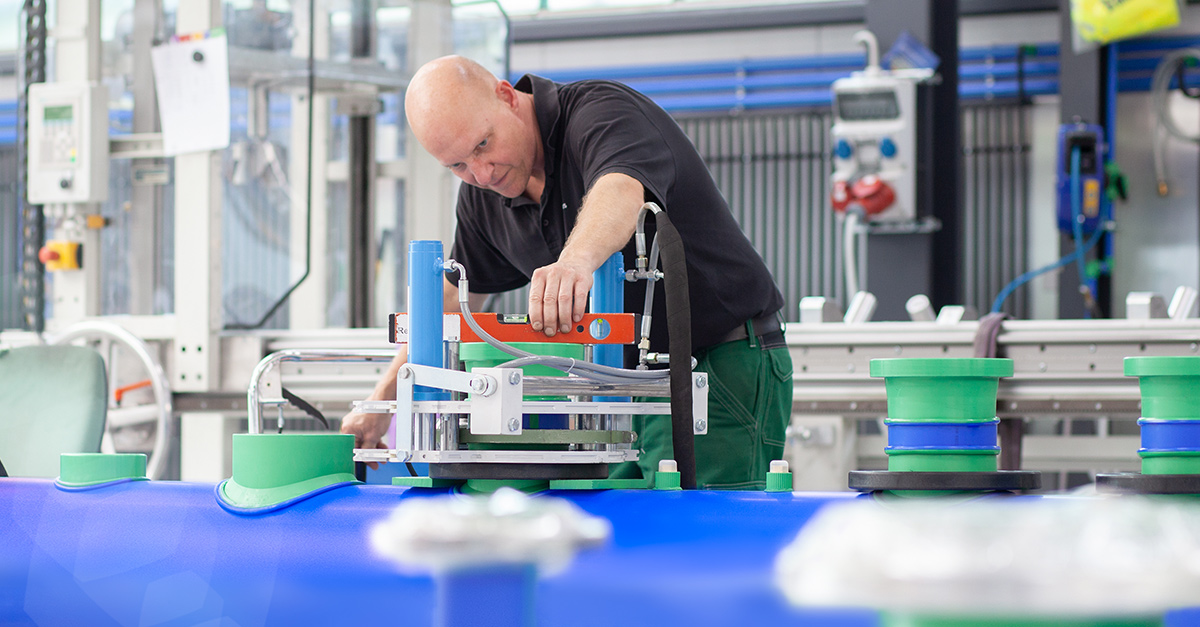
In pipework construction, prefabrication refers to the manufacture of manifolds, special components, or complete system components off-site under controlled conditions in the factory. The prefabricated elements are then delivered ready for assembly and simply installed on site.
This form of industrial prefabrication offers advantages: it enables complex components to be planned precisely and manufactured independently of external factors such as weather or space constraints. This significantly improves quality, predictability and efficiency in construction.
## Why is prefabrication a good idea?
Architects, planners and site managers regularly face the challenge of reconciling technical requirements, scarce resources and bespoke solutions in construction projects. In pipework construction in particular, the workload increases when complex distribution systems or special components need to be integrated into a project with precision.
Prefabrication is beneficial in such cases, as it shifts demanding tasks from the construction site to a controlled environment. This improves reliability of execution, supports consistent quality and reduces pressure on the trades involved. Prefabrication is particularly worthwhile when precision and smooth processes are crucial.
## An overview of the key benefits of prefabrication
In day-to-day construction, prefabrication offers a number of concrete benefits. Which of these are particularly significant depends on the project, structural conditions, and technical requirements.
### Greater planning certainty and fewer delays
A key advantage of prefabrication in construction is greater planning reliability. As complex components in pipework do not have to be created on-site, processes can be coordinated more precisely, better organised, and prepared more reliably in advance.
This reduces coordination efforts, shortens installation times and minimises the risk of unplanned delays. For construction projects with tight timeframes, this means that deadlines can be met more reliably and construction progress remains stable. [Prefabrication](https://blog.aquatherm.de/en/prefabrication-how-to-make-construction-projects-more-efficient) therefore enables construction projects to be implemented [more efficiently.](https://blog.aquatherm.de/en/prefabrication-how-to-make-construction-projects-more-efficient)
### Countering the shortage of skilled workers with prefabrication
Especially in times of a shortage of skilled workers, the efficient use of [human resources](https://blog.aquatherm.de/en/human-ressource-solution-approaches-for-the-optimisation-of-skilled-labour-in-the-construction-industry) is crucial. If qualified fitters and specialists are to be deployed in a targeted manner on the construction site, prefabrication can provide significant relief.
As complex manifolds and special components do not need to be manufactured on site, the manpower required on the construction site is reduced. Existing skilled workers can focus more on central assembly and coordination tasks, rather than undertaking time-consuming individual steps under site conditions.
### Meeting individual requirements in plant engineering
In plant and piping construction, standardised solutions quickly reach their limits. Many projects require components that are precisely tailored to spatial, technical or media-related requirements.
This is precisely where the advantages of prefabrication come to the fore: bespoke solutions can be planned and manufactured precisely in accordance with the respective project specifications. This results in tailor-made systems that fit perfectly with the requirements of the respective construction project.
### Wide-ranging applications of prefabrication in construction
Prefabrication in pipework construction demonstrates its advantages in many different areas of application. Whether new builds or refurbishments, heating or cooling, open or closed systems: prefabricated solutions can be adapted to various technical requirements.
This also offers clear added value in the case of challenging geometries and specific structural conditions. Even complex installation scenarios can be implemented with a perfect fit if systems are planned and prepared at an early stage to meet the specific project requirements.
## Advantages of prefabrication in practice: two examples
Specific construction projects demonstrate how the benefits of prefabrication play out in practice. The following examples illustrate the situations in which this approach proves its worth and the added value it can offer for planning, installation and implementation.
### Tight time constraints on the UN Campus
During the new-build project on the [UN Campus in Bonn](https://www.aquatherm.de/en/solutions-products/references/un-campus-germany/), a sophisticated sprinkler system had to be integrated into a complex building design. At the same time, it was necessary to meet the tight deadlines for the structural work and keep the workload on site to a minimum.
The use of prefabricated elements enabled better coordination of workflows, ensured on-time deliveries and reduced the amount of work required on site. This made it easier to adhere to the construction schedule, minimised material logistics on site and facilitated the targeted deployment of installation staff.
### Reduced effort required in the cramped technical room of the Centre for Integrated Oncology (CIO)
At the [Centre for Integrated Oncology](https://www.aquatherm.de/en/solutions-products/references/centre-for-integrated-oncology-germany/) on the campus of Cologne University Hospital, high technical requirements clashed with a tight schedule and limited space in the plant room.
It was precisely under such conditions that the advantages of prefabrication became particularly evident. Solutions planned and prepared in advance reduced the workload on site, supported a stable schedule and facilitated implementation in the confined environment.
## How aquatherm supports prefabrication projects
The benefits of prefabrication can be fully realised when planning, manufacturing and subsequent installation are seamlessly integrated. aquatherm supports this approach with solutions tailored to the requirements of each project and prepared for use on site.
- **Factory production:** The respective plastic piping system is manufactured and assembled in a clean environment across 1,650 square metres of production space, ensuring the end result is not affected by adverse installation conditions.
- **Customisation:** Manifolds and special components are manufactured to the customer’s individual specifications, ensuring precise alignment with the technical and spatial requirements of the construction project.
- **Ready-to-install delivery:** The components are prepared for assembly to reduce installation effort on site and simplify on-site integration.
- **Worldwide shipping:** The required components are delivered to any location worldwide, ensuring that international projects can be reliably supplied and implemented according to schedule.
- **Flexibility:** We can respond quickly to project-specific requirements and last-minute changes, as production has direct access to stock and the necessary components.
This demonstrates the *advantages of prefabrication* across a wide range of applications, such as new builds and refurbishments, heating and cooling systems, and open and closed applications. Even complex designs and special installation scenarios can be reliably implemented with precisely tailored components.
## Conclusion: This is why prefabrication makes sense
The practical examples and areas of application demonstrate that the benefits of prefabrication pay off wherever construction projects need to be planned precisely, individual requirements implemented reliably, and on-site processes streamlined. It provides greater planning certainty, supports consistent quality, and facilitates implementation even under complex conditions.
Drawing on our experience from a wide range of projects, we support companies with our [aquatherm services](https://www.aquatherm.de/en/solutions-products/products/aquatherm-services/) in developing suitable solutions for their requirements and integrating prefabrication effectively into project planning. Find out what matters most in our guide:
[](https://hubspot-cta-redirect-eu1-prod.s3.amazonaws.com/cta/redirect/25129160/c5da011b-b9cb-4434-a199-10fe764cd6e1)
### Related posts
## [How aquatherm supports you with prefabrication](https://blog.aquatherm.de/en/how-aquatherm-supports-you-with-prefabrication)
26\. July 2022
If you decide to use prefabricated components for your future plastic piping system, you have a strong partner at your side with aquatherm, who shall...
Reading time: 2 Min.
## [Prefabrication: How to make construction projects more efficient](https://blog.aquatherm.de/en/prefabrication-how-to-make-construction-projects-more-efficient)
23\. April 2026
Changes to plans, extensive coordination between trades, and logistical bottlenecks are part of everyday life on many construction sites....
Reading time: 3 Min.
## [Invisible security in the building](https://blog.aquatherm.de/en/invisible-security-in-the-building)
29\. April 2024
Sprinkler systems play a central role as one of the most widely used and effective solutions in fire protection. In an emergency, they save lives and...
Reading time: 5 Min.
[To overview page](https://blog.aquatherm.de/)
#### Topics
- [BIM (3)](https://blog.aquatherm.de/en/tag/bim)
- [District heating (14)](https://blog.aquatherm.de/en/tag/district-heating)
- [Drinking water (7)](https://blog.aquatherm.de/en/tag/drinking-water)
- [Further topics (13)](https://blog.aquatherm.de/en/tag/further-topics)
- [Maritime applications (4)](https://blog.aquatherm.de/en/tag/maritime-applications)
- [Modern data centre cooling (12)](https://blog.aquatherm.de/en/tag/modern-data-centre-cooling)
- [Prefabrication (4)](https://blog.aquatherm.de/en/tag/prefabrication)
- [Processing (3)](https://blog.aquatherm.de/en/tag/processing)
- [Surface heating & cooling (5)](https://blog.aquatherm.de/en/tag/surface-heating-cooling)
Show more
---
#### Top 5 Posts
| 1 | [Backflow preventers in drinking water systems: What matters](https://blog.aquatherm.de/en/backflow-preventers-in-drinking-water-systems-what-matters) |
| --- | --- |
| 2 | [Drinking water supply: Systems, planning and infrastructure](https://blog.aquatherm.de/en/drinking-water-supply-systems-planning-infrastructure) |
| 3 | [Drinking water hygiene: What matters in building installations](https://blog.aquatherm.de/en/driniking-water-hygiene-what-matters-in-building-installations) |
| 4 | [Ensuring reliable drinking water quality in projects](https://blog.aquatherm.de/en/ensuring-reliable-drinking-water-quality) |
| 5 | [Legionella in drinking water: Responsibilities & prevention](https://blog.aquatherm.de/en/legionella-in-drinking-water-responsibilities-prevention) |
---
### Subscribe to our newsletter:
Deutschland
aquatherm GmbH | Biggen 5
57439 Attendorn | Germany
Phone: **+49 2722 950 0**
Mail: **info@aquatherm.de**
[Contact](https://www.aquatherm.de/en/company/contact/)
Newsletter abonnieren
Закрыть
- - APPLICATION FIELDS
- [Heating system construction](https://www.aquatherm.de/en/solutions-products/applications/heating-system-construction/)
- [Refrigeration](https://www.aquatherm.de/en/solutions-products/applications/refrigeration/)
- [Heating and cooling networks](https://www.aquatherm.de/en/solutions-products/applications/heating-and-cooling-networks/)
- [Fire protection and sprinkler systems](https://www.aquatherm.de/en/solutions-products/applications/fire-protection-and-sprinkler-systems/)
- [All applications](https://www.aquatherm.de/en/solutions-products/applications/)
- - INDUSTRIES
- [Data centres](https://www.aquatherm.de/en/solutions-products/industries/data-centres/)
- [Infrastructure](https://www.aquatherm.de/en/solutions-products/industries/infrastructure/)
- [Health sector](https://www.aquatherm.de/en/solutions-products/industries/health-sector/)
- [Industrial buildings](https://www.aquatherm.de/en/solutions-products/industries/industrial-buildings/)
- [All sectors](https://www.aquatherm.de/en/solutions-products/industries/)
- - Service
- [Knowledge Base](https://www.aquatherm.de/en/aquatherm-knowhow/knowledge-base/)
- [Planning tools](https://www.aquatherm.de/en/aquatherm-knowhow/planning-tools/)
- [Trainings](https://www.aquatherm.de/en/aquatherm-knowhow/trainings/)
- [Contact](https://www.aquatherm.de/en/company/contact/)
- [All services](https://www.aquatherm.de/en/aquatherm-knowhow/)
- - Quicklinks
- [Blog](https://blog.aquatherm.de/en)
- [News](https://www.aquatherm.de/en/company/news/)
- [Frequently asked questions](https://www.aquatherm.de/en/aquatherm-knowhow/knowledge-base/frequently-asked-questions/)
- - Products
- [aquatherm black](https://www.aquatherm.de/en/solutions-products/products/aquatherm-black/)
- [aquatherm blue](https://www.aquatherm.de/en/solutions-products/products/aquatherm-blue/)
- [aquatherm green](https://www.aquatherm.de/en/solutions-products/products/aquatherm-green/)
- [aquatherm red](https://www.aquatherm.de/en/solutions-products/products/aquatherm-red/)
- [aquatherm energy](https://www.aquatherm.de/en/solutions-products/products/aquatherm-energy/)
- [aquatherm services](https://www.aquatherm.de/en/solutions-products/products/aquatherm-services/)
- [All products](https://www.aquatherm.de/en/solutions-products/products/)
- - References
- [Orsolina28, Italy](https://www.aquatherm.de/en/solutions-products/references/orsolina28-italy/)
- [“mikado”, Germany](https://www.aquatherm.de/en/solutions-products/references/mikado-germany/)
- [DJO, Germany](https://www.aquatherm.de/en/solutions-products/references/djo-germany/)
- [Multivac, Germany](https://www.aquatherm.de/en/solutions-products/references/multivac-germany/)
- [Spree tower, Germany](https://www.aquatherm.de/en/solutions-products/references/spree-tower-germany/)
- [Vioser S.A., Greece](https://www.aquatherm.de/en/solutions-products/references/vioser-sa-greece/)
- [All references](https://www.aquatherm.de/en/solutions-products/references/)
- - Company
- [About us](https://www.aquatherm.de/en/company/about-us/)
- [Locations](https://www.aquatherm.de/en/company/locations/)
- [News](https://www.aquatherm.de/en/company/news/)
- [Everything about the company](https://www.aquatherm.de/en/company/)
---
Copyright © 2026 aquatherm GmbH. All rights reserved.
EN
---
- [Privacy policy](https://www.aquatherm.de/en/privacy-policy/)
- [Imprint](https://www.aquatherm.de/en/imprint)
- [Legal notice](https://www.aquatherm.de/en/legal-notice/)
- [T&Cs](https://www.aquatherm.de/en/tcs)
---
---
All content presented on this regional aquatherm website applies globally.
[Back to top](https://blog.aquatherm.de/en/prefabrication-practical-benefits#top)
```json
{
"@context" : "https://schema.org",
"@type" : "BlogPosting",
"author" : {
"@type" : "Person",
"name" : "Admin",
"url" : "https://blog.aquatherm.de/en/author/admin"
},
"dateModified" : "2026-04-23T11:29:51.276Z",
"datePublished" : "2026-04-23T09:23:06.000Z",
"headline" : "Prefabrication: Practical benefits",
"image" : [ "https://blog.aquatherm.de/hubfs/Blog/Vorteile%20bei%20der%20Vorfertigung/vorteile-bei-der-vorfertigung.jpg" ],
"mainEntityOfPage" : {
"@id" : "https://blog.aquatherm.de/en/prefabrication-practical-benefits",
"@type" : "WebPage"
},
"publisher" : {
"@type" : "Organization",
"logo" : {
"@type" : "ImageObject",
"url" : "https://blog.aquatherm.de/hubfs/aquatherm_Logo_RGB_gradient-green_mSZ.png"
},
"name" : "aquatherm GmbH"
}
}
```